We measured which work people shouldn’t have to do on a real estate project anymore
Real estate projects are becoming more complex, more information is being generated, and the demands on project management keep growing. Yet we still handle much of this growing complexity with one and the same resource: people’s time. At WHAT IF, we broke down our project managers’ work and asked which activities actually require an experienced project manager – and which ones a person shouldn’t have to do at all anymore.
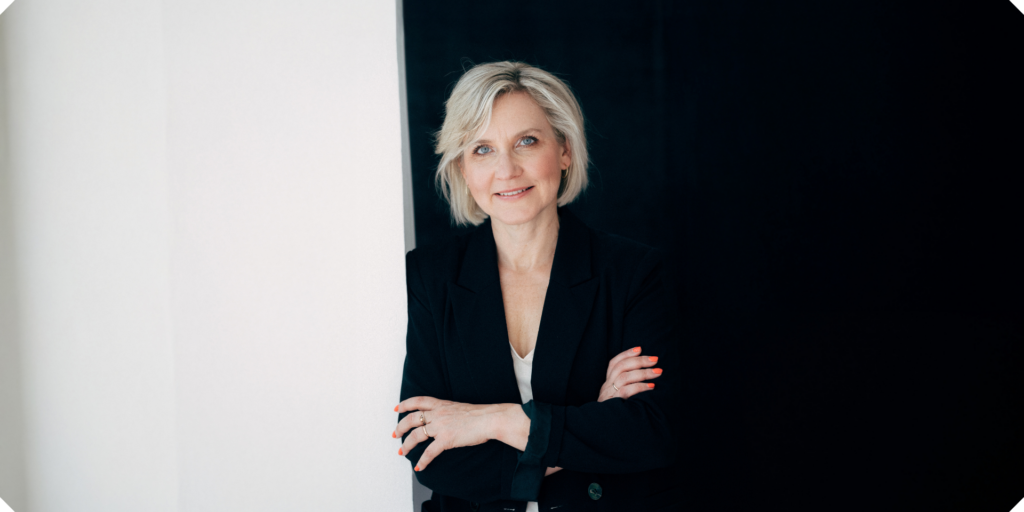
Külli Tulvik, Head of Development Services at WHAT IF
In real estate development, we talk a lot about how to manage projects better. We make more precise schedules, create new processes, adopt new platforms and add checkpoints. At the same time, the project itself has become increasingly information-heavy. Design constantly produces new versions, decisions are made in different places, requirements keep piling up, and over the course of a single project an enormous amount of documentation and history accumulates.
Much of this complexity eventually lands on the project manager’s desk.
When it isn’t immediately clear which document is valid, the project manager checks. When a new drawing arrives, someone has to figure out what changed. When a question comes up about a decision made six months ago, someone digs up its background. When two pieces of information contradict each other, we often rely on an experienced person to notice.
A good project manager compensates for a great deal of the system’s shortcomings with their experience, memory and time. They know how to find information, they know the project’s history, and they can piece together a large amount of fragmented information into a whole in their head.
But is that really what we want to pay a good project manager for?
We broke the project manager’s work down into activities
This question has become increasingly important at WHAT IF in recent years. Not because we want to shrink the project manager’s role – quite the opposite: we want to use their expertise where it has the greatest impact.
Külli is a project manager at WHAT IF. Her value to the client lies in understanding the project as a whole, seeing the consequences of changes, spotting risks, managing the various parties and helping the client make better decisions.
Yet her workday is also made up of dozens of activities that don’t actually require her professional expertise. You don’t need a good project manager to find a file. You don’t need a good project manager to spot differences between two drawings. Finding a decision from six months ago shouldn’t require a good memory.
We took Külli’s daily workflows and started measuring how much time these activities actually take – and what changes when Franklin handles part of the information processing for her.
The goal wasn’t to find out how many clicks some new tool saves, but something more fundamental: how much of a project manager’s current work could we take off their plate entirely?
A project manager shouldn’t have to start by hunting for the change
Take one of the most common situations: a new drawing version arrives on the project.
For the project manager, the real question isn’t whether a wall, a dimension or a technical solution changed on the drawing. The question is what that change means for the project.
Which other parts of the project are affected?
Does it create a new conflict?
Does the change affect the budget or the schedule?
Does anything that was already approved, or even under construction, need to be revisited?
Traditionally, before getting to these questions, the project manager has to complete a first step: find the changes between the two drawings. In our measurements, comparing drawings could take roughly 30–60 minutes. With Franklin, the time needed to identify the changes dropped to roughly 5–10 minutes.
BEFORE → WITH FRANKLIN
Comparing two drawing versions
30–60 min 5–10 min
Finding routine information
5–15 min < 2 min
Reconstructing the background of an older decision
20–60 min a few minutes
Total: several hours per week, per project
An 80% time saving matters, but what matters even more is the point from which a person starts their work. If software can surface what changed in the information, the project manager doesn’t have to spend their attention looking for the change. They can use it to assess the impact.
The difference may seem small, but to us it describes quite precisely where project management is heading. The value of technology isn’t that a person does the same analysis faster. Technology should take care of processing the information so that people can focus on what it means.
The same problem repeats throughout the project
Drawings are just one example. Another big part of a project manager’s work is holding the project’s memory.
“Which version did we approve?”
“What did we decide about this?”
“Was this change already in the previous version?”
“When did this solution change?”
These are simple questions – until you need to give a definitive answer.
In our measurements, finding routine information could take 5–15 minutes. Reconstructing the background of an older decision or change could mean 20–60 minutes of work. With Franklin, simpler searches often dropped below two minutes, and reconstructing longer project history came down to a few minutes.
Here too, the most important question for us isn’t how many minutes faster the search became. It’s why a highly qualified project manager should have to be the person through whom the project’s memory is accessed at all.
Today, much of a project’s knowledge still lives in folders, inboxes, meeting minutes and people’s heads. A very good project manager can connect the dots between them. But the larger and longer the project, the more fragile that model becomes. People change, memory fades, and at the end of the project, years of accumulated information has to be pieced back together.
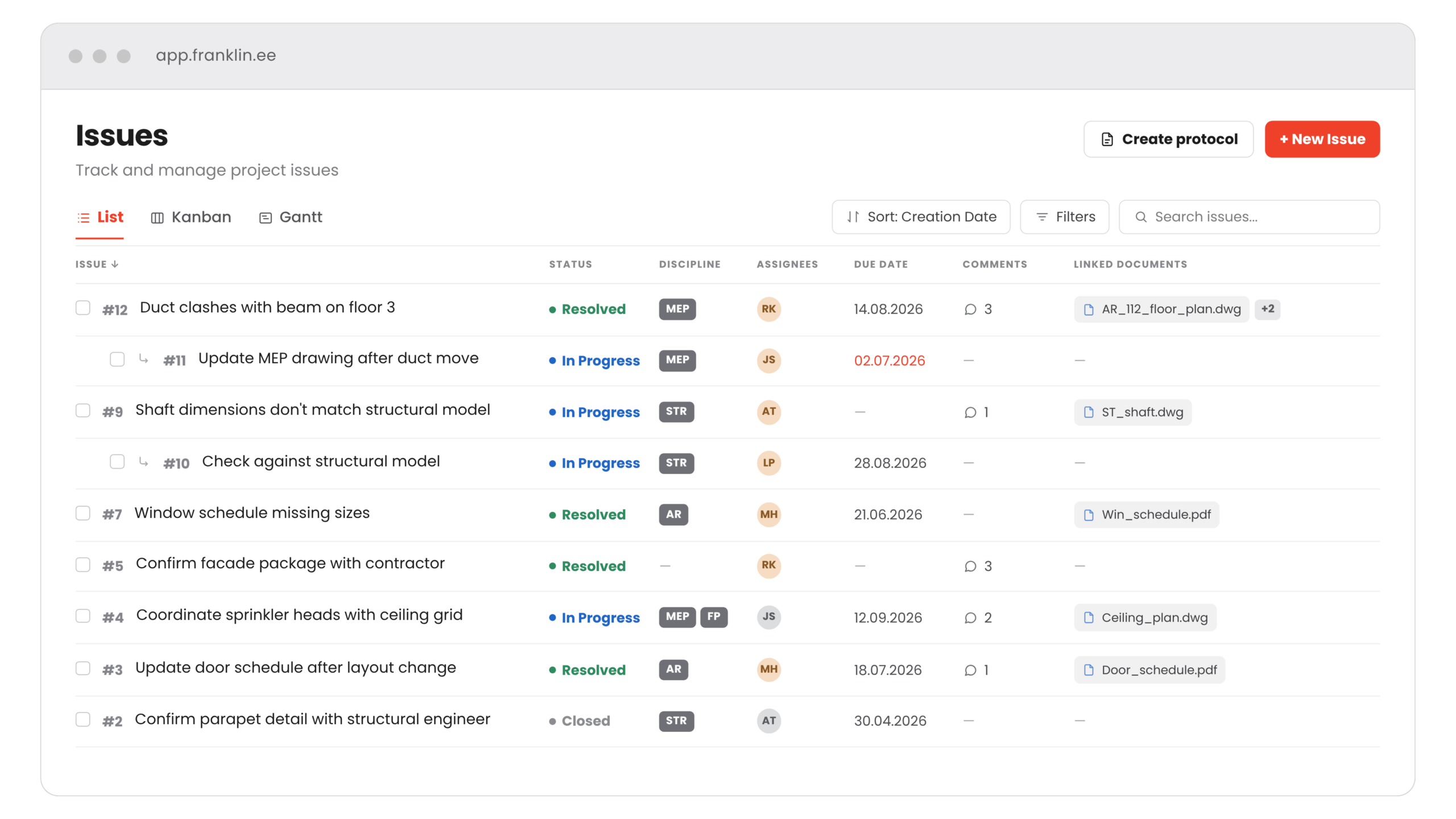
That’s why simply making documents easier to find isn’t enough for us. What matters is that connections form between them as the project progresses. In Franklin, for example, you can link a task directly to the drawing or document it’s based on, and conversely see the related issues right next to a document. That way, it’s not just the file that remains, but the context too: what problem arose, what was done to resolve it, and which other parts of the project it was connected to.
This means the project’s memory doesn’t have to be rebuilt after the fact. It’s created in the course of managing the project.
For us, the project itself should increasingly remember its own history.
PROJECT MANAGEMENT VIEW · FRANKLIN
A project manager doesn’t lose a day. They lose it ten minutes at a time.
When we started measuring our workflows, one observation stood out: a project manager’s time usually isn’t eaten up by one big administrative task.
It disappears in small interruptions.
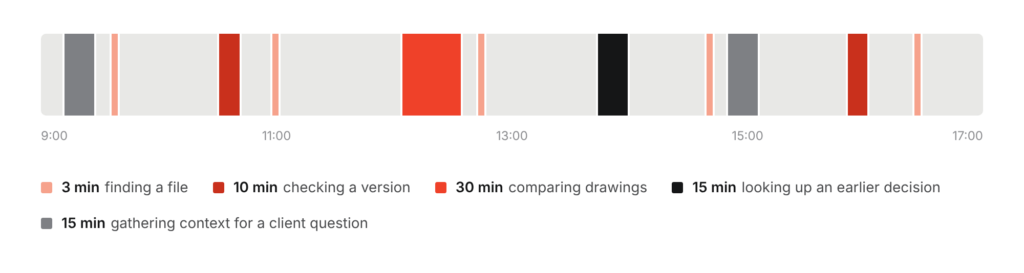
A few minutes to find a file, ten minutes to check a version, half an hour to compare changes, fifteen minutes to look up an earlier decision. Then a client question comes in, and answering it first requires gathering context from several different places.
A PROJECT MANAGER’S DAY · ILLUSTRATIVE EXAMPLE
Individually, these tasks don’t seem big enough to treat as a management problem. Over a week, they add up to hours. Over a project, to days. Across multiple project managers and an entire project portfolio, the impact is significant.
Our measurements so far show that reducing these activities can give a project manager back several hours of working time per week, per project.
But here too, it would be too simple to conclude that the gain is just that the same person can now get through more tasks.
The question isn’t how a project manager can do more
If technology gives an experienced project manager several hours back each week, the least interesting use of that time would be to simply fill it with new administrative tasks.
A project manager’s most valuable resource is their attention.
It’s needed at the moment a change could affect the budget. When designers’ solutions start clashing with each other. When a risk emerges in the schedule. When the client has to choose between two bad alternatives. When a problem is still small enough that fixing it doesn’t cost much.
These are the moments where a good project manager creates value for the client.
That’s why at WHAT IF we don’t see technology only as a way to do existing tasks faster. We look increasingly critically at the work process itself: why is this task on a person’s desk in the first place?
That’s a much bigger shift than digitalising a process.
This also changes the role of a project management company
The traditional business logic of a project management company is largely tied to people’s time. A project needs a certain amount of management, so we put a certain number of people’s working hours into the project.
Technology makes that logic increasingly uncomfortable.
If part of the work that used to take an hour now takes ten minutes, our ambition can’t be to keep selling the client that hour. If checking, comparing and structuring information can be done by a machine, human work has to move to where human expertise creates more value.
This means that in management work, value in the future can’t lie in how much administrative work people can get through. It has to lie in how well we can manage the project, prevent risks and improve the client’s decisions.
Franklin was born inside WHAT IF out of a very practical need to make our own work more efficient. But the more we use and measure it in our projects, the less it seems to us that the question is simply about efficiency.
Step by step, we are changing what our own service is made of.
So what do we need a project manager for?
Not to remember which folder a file is in. Not to compare two drawings by hand. Not to spend half an hour looking for a decision from six months ago. We need them to understand what all of it means.
To see connections that project participants don’t see on their own. To spot a risk before it becomes a problem. To know which question to ask. To help the client make a decision whose impact may last for decades.
We started building Franklin with the question of how to make project managers’ work more efficient. Today, we’re more interested in the next question:
which part of today’s project management should still be human work five years from now?
In answering that question, we’re building both Franklin and WHAT IF itself.