How we’re rebuilding project management at WHAT IF
The client’s brief sets a minimum shower area of 900 × 900 mm. Yet in several bathrooms, the interior architect’s drawings show showers measuring 700 × 800 mm. The same project also contains inconsistencies in the number of light fixtures and in socket installation heights.
These aren’t unusual errors in real estate development. What’s unusual is that this time, they weren’t caught by a person.
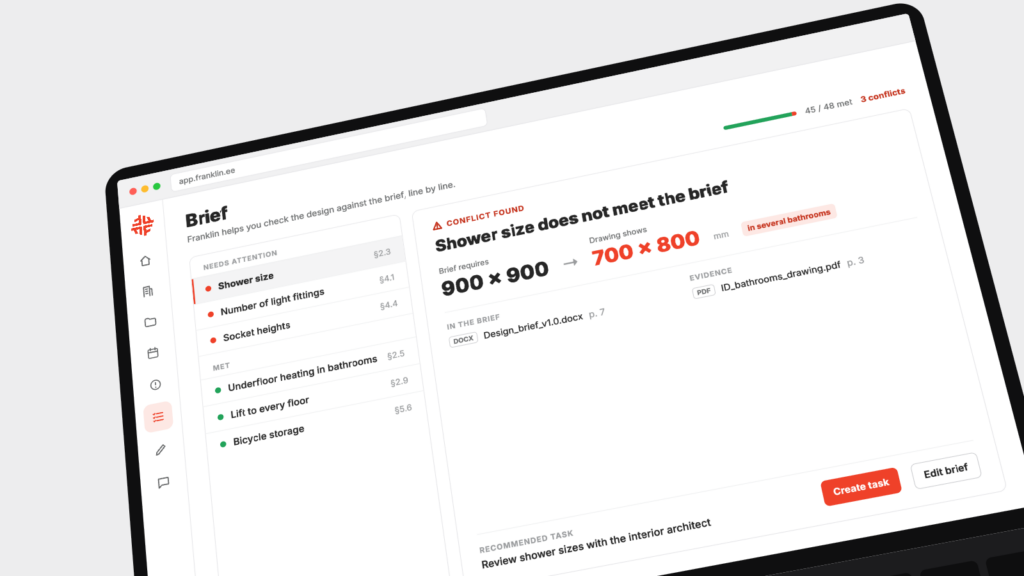
At WHAT IF, we have set out to redesign how real estate projects are managed. In our day-to-day work we use Franklin, an AI-powered project environment we built ourselves. It creates a digital memory for the building, checks project documentation, detects inconsistencies, and helps set next steps and priorities.
For decades, project management capacity has depended largely on how much information one person can work through. Technology now lets us move past that limit.
Our goal is not simply to speed up existing workflows. We want to change how project management itself is organised. Quality control becomes a continuous process instead of a periodic one, and the project manager’s attention shifts from searching for and checking information to making decisions, preventing risks and managing the project’s financial outcome.
What’s new in Franklin, and how does it change our work?
1. Continuous checks against the brief
Franklin’s AI agent lets us check that project documentation matches the client’s brief throughout the entire design process. This helps us catch deviations before they move on to the next project stage.
2. Automatic detection of project inconsistencies
Franklin compares documents, drawings, their versions and the decisions made in the project, and brings possible inconsistencies to the project manager’s attention. Instead of spending time looking for problems, we can focus on solving them.
3. The building’s digital memory
Franklin brings the building’s documentation, changes, decisions and their history together into a single digital memory that grows throughout the project. Project knowledge no longer depends on individual people’s memories, email threads or information scattered across different systems.
The building’s memory shows not only where the project stands today, but also why it got there and which decisions led to it. This lays the foundation for keeping knowledge intact from design through construction and into facility management.
4. AI supports weekly project management
Franklin analyses the project’s current status, documentation, open questions and outstanding obligations, and helps put together the week’s tasks and set priorities.
The project manager gets an overview of which decisions need attention, where delays may arise, and which actions matter most for moving the project forward. Project management becomes more proactive: problems can be dealt with before they start to affect the schedule or the budget.
5. All project information available to AI assistants
An MCP interface lets you connect Franklin to ChatGPT, Claude and other AI assistants. This means we can use project documentation, decision history and the building’s digital memory across different workflows, without having to gather the information by hand every time.
6. Next step: automatic quantity checks and cost estimation
We are developing a module that identifies construction quantities from project documentation and tracks how design changes affect the budget. The aim is to make the financial impact of design decisions visible as early as possible.
What does this mean for developers, building owners and facility managers?
Less time spent searching for and checking information. Fewer inconsistencies discovered too late. A clearer view of project priorities and open issues. Faster, better-informed decisions.
Another important change is how project knowledge is kept. Building information and decision history don’t disappear when people change or project stages end. They stay usable throughout the building’s entire lifecycle.
For WHAT IF, this means we can grow our project management capacity without growing the team at the same rate. For the client, it means closer control over the project, a better overview of decisions, and a lower risk that major problems are only found once they’ve become expensive to fix.